
New to Cyprus
Getting a car in Cyprus, without the surprises.
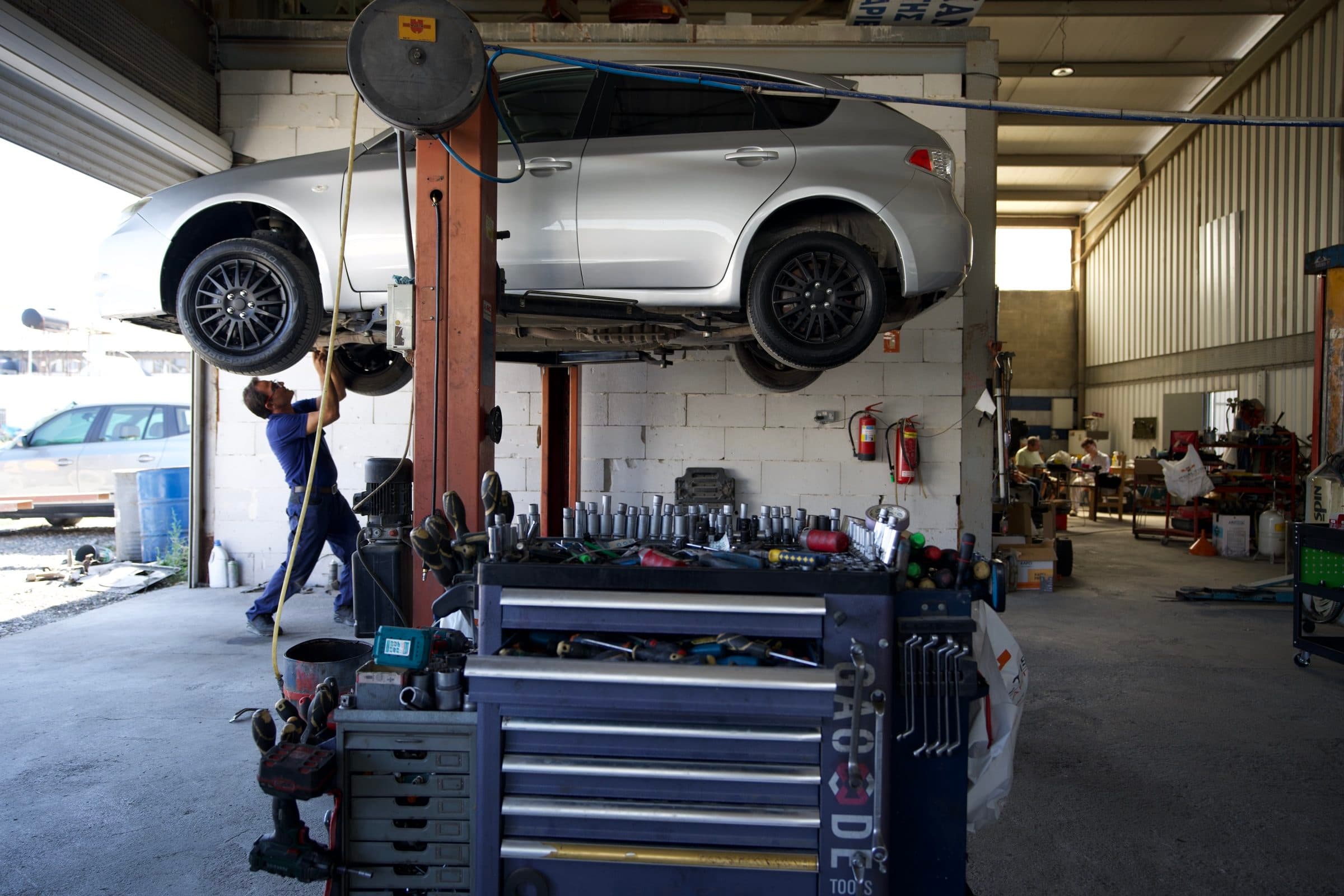
Just arrived and need a car? A few things work differently here: traffic keeps left, most cars are right-hand drive, and the roadworthiness test is called MOT. Here is what that means in practice — from a Larnaca garage that answers these questions every week.
First things first
In Cyprus, you drive on the left.
Cyprus was a British colony, and left-hand traffic stayed. Most cars on the island are therefore right-hand drive: the wheel sits on the right and you shift with your left hand. The pedals stay exactly where you expect them. In our experience the first few roundabouts are the real adjustment — after a few days almost nobody thinks about it any more.
- Wheel on the right, pedals unchanged
- Clutch, brake and accelerator keep the same order. What changes is your shifting hand and the direction you look first.
- Roundabouts run clockwise
- You enter to the left and give way to traffic coming from your right — a mirror image of mainland Europe.
- Speeds in km/h
- Unlike the UK, Cyprus is metric. Signs and speedometers read in kilometres.
Your country and Cyprus, side by side
What works differently here.
The differences that matter, in one place. Pick the country you are coming from.
Traffic keeps
United Kingdom
left
Cyprus
left
Steering wheel
United Kingdom
right
Cyprus
right
Roundabouts
United Kingdom
clockwise
Cyprus
clockwise
Priority in a roundabout
United Kingdom
from the right
Cyprus
from the right
Roadworthiness test
United Kingdom
MOT
Cyprus
MOT
Registration authority
United Kingdom
DVLA
Cyprus
Department of Road Transport
Number plates
United Kingdom
stay with the vehicle
Cyprus
stay with the vehicle
Motorway speed
United Kingdom
70 mph (≈ 112 km/h)
Cyprus
100 km/h — with a 65 km/h minimum
National roads
United Kingdom
70 mph (≈ 112 km/h) on dual carriageways
Cyprus
80 km/h
Country roads
United Kingdom
60 mph (≈ 97 km/h) on single carriageways
Cyprus
65 km/h
Built-up areas
United Kingdom
30 mph (≈ 48 km/h)
Cyprus
50 km/h
Winter tyres
United Kingdom
not required
Cyprus
a non-issue on the coast — not in the Troodos
Emergency number
United Kingdom
999 or 112
Cyprus
112
On the road
Rules you need on day one.
Much of it you know from the EU. These six still catch new arrivals out.
Seatbelts
In every seat, front and back — and enforced consistently.
Phones hands-free only
Holding a phone while driving is prohibited, including while stopped at lights.
Drink-driving
Cyprus sets strict limits, lower for newly qualified drivers than for experienced ones. The simple rule holds: if you drive, you do not drink.
Children in the car
A child seat by size and age, as across the EU. Not in the front seat with an active airbag.
Yellow lines at the kerb
A British inheritance: a single yellow line means restricted stopping, a double yellow means no stopping.
Emergency number 112
Works in Cyprus exactly as at home — with no credit and even with no SIM.
Your first decision
Buy here, or bring your own car over?
Both work. We will tell you plainly which suits your case — even when the honest answer is to leave your car at home.
Buy on the island
- Right-hand drive suits left-hand traffic: you see far more when overtaking.
- No shipping, no import procedure, no foreign re-registration.
- Garages and parts suppliers here are set up for these models.
- Reselling later in Cyprus is noticeably easier.
Bring your own car
- You already know the car's condition, history and service record.
- Left-hand drive in left-hand traffic makes overtaking and kerbside windows awkward.
- Add shipping, registration and Cyprus registration duty on top.
- Left-hand-drive cars are harder to sell on the island later.
The road to plates
What happens between the handshake and the registration.
The process is manageable once you know it. Five steps, in this order.
- 01
Sort your licence
An EU licence is valid in Cyprus. If you are registering as a resident, check early whether and when an exchange becomes necessary.
- 02
Have the car inspected
Before you buy, not after. Heat and salt air are harder on cars here than in central Europe — air-conditioning, cooling and the underbody are the usual weak points.
- 03
Transfer ownership
The change of ownership goes through the Department of Road Transport, with buyer and seller signing together.
- 04
MOT and road tax
Cyprus tests vehicles through the MOT. Older cars need a valid certificate, and annual road tax applies.
- 05
Arrange insurance
Third-party cover must be in place before the car moves for the first time.
The market on the island
Where the used cars actually are.
Four routes to a car. What separates them is mostly how much you get to learn about its past.
Bazaraki
The country's largest classifieds market. Nearly every privately owned car on the island passes through bazaraki.com eventually.
Local dealers
Shorter paths through paperwork and warranty, and usually higher prices than a private sale.
Newcomer community groups
Plenty of cars change hands directly between new arrivals — often well kept, but often without a service record.
Imports from Japan and the UK
A large share of the cheaper stock arrived as a right-hand-drive import. Frequently sound mechanically; what is usually missing is the service history.
Paperwork
What to bring to the transfer.
Buyer and seller sign the change of ownership together. With this folder you are ready.
Paperwork
- Passport or national ID card
- Your driving licence
- Proof of your address in Cyprus
- The vehicle's registration document
- A valid MOT certificate, where the vehicle needs one
- Proof of insurance — before the first drive
- For non-EU nationals: your residence document
From the workshop
What the island climate does to cars.
A car ages differently in Cyprus than in central Europe. These are the places we see it first.
Summer heat above 40 °C
Air-conditioning, radiator and fans run at their limit here. Batteries age markedly faster in this climate than in Germany.
Salt air on the coast
Underbody, brake lines and exhaust suffer more near the sea. A look from underneath tells you more than the paintwork.
Dust from the Sahara
When Saharan dust drifts over the island, cabin and air filters clog remarkably quickly.
Short trips in the heat
Diesels with a particulate filter dislike city traffic in high temperatures. If most of your trips are short, petrol or hybrid is often the better call.
Tyres age in UV
Here the age of the rubber counts, not just the tread depth. The DOT code on the sidewall gives you the year.
The Troodos in winter
There is snow in the mountains, and long descents ask a lot of the brakes. If you are driving up there, know the state of your brakes and tyres.
What we can do for you
Before you buy, let us look at it.
Found a car, privately or at a dealer? Bring it in, or send us the listing. We will go over it and tell you what we find — including when the answer is to walk away. A second opinion before you buy costs less than the first repair after.
In person we advise in English and Greek. You are welcome to write in German — we will make sure you get an answer you understand.
What we look at
- Engine, gearbox and electronics on diagnostics
- Air-conditioning and cooling — critical on this island
- Underbody, corrosion and signs of earlier accidents
- Brakes, tyres and suspension
- Fluids, belts and service due
- A straight verdict: buy, negotiate, or leave it
Common questions
Does Cyprus drive on the left?
Yes. Cyprus kept left-hand traffic from the British era. Most vehicles on the island are right-hand drive, but speeds are posted in km/h.
Is my EU driving licence valid in Cyprus?
Yes, an EU licence is valid in Cyprus. If you move your residence to Cyprus permanently, check with the authorities whether an exchange is required.
Should I bring my car from Germany?
Usually it is simpler to buy a right-hand-drive car on the island: better visibility in left-hand traffic, no shipping, no import procedure and an easier resale. If you are attached to your car, importing is of course still possible.
What is the MOT?
The MOT is the Cypriot roadworthiness test, comparable to the German TÜV. Older vehicles need a valid certificate.
Will you inspect a car I have not bought yet?
Yes — that is exactly what we offer newcomers. Bring the car in or send us the listing, and we will look at it before any money changes hands.
How do I even find used cars in Cyprus?
Most of the market runs through the classifieds site bazaraki.com, alongside local dealers, the newcomer community groups, and right-hand-drive imports from Japan and the UK.
What does running a car in Cyprus cost?
On top of road tax, which is based on emissions and engine size, come insurance, the MOT and fuel. The actual amounts change regularly — your insurer and the Cypriot authority are the binding sources.
Are Japanese imports a good idea?
They make up a large share of the cheaper stock and are often mechanically sound. The catch is the missing service history — which is precisely why an inspection before buying pays off on these cars.
Do I need winter tyres in Cyprus?
Not on the coast. If you drive into the Troodos mountains in winter, have your tyres and brakes checked — there is snow up there.
Ready when you are.
Book a service, ask a question, or come in for a chat — no appointment feels like a hassle here.